Driving the North Coast of Scotland in a Caterham 270 SV
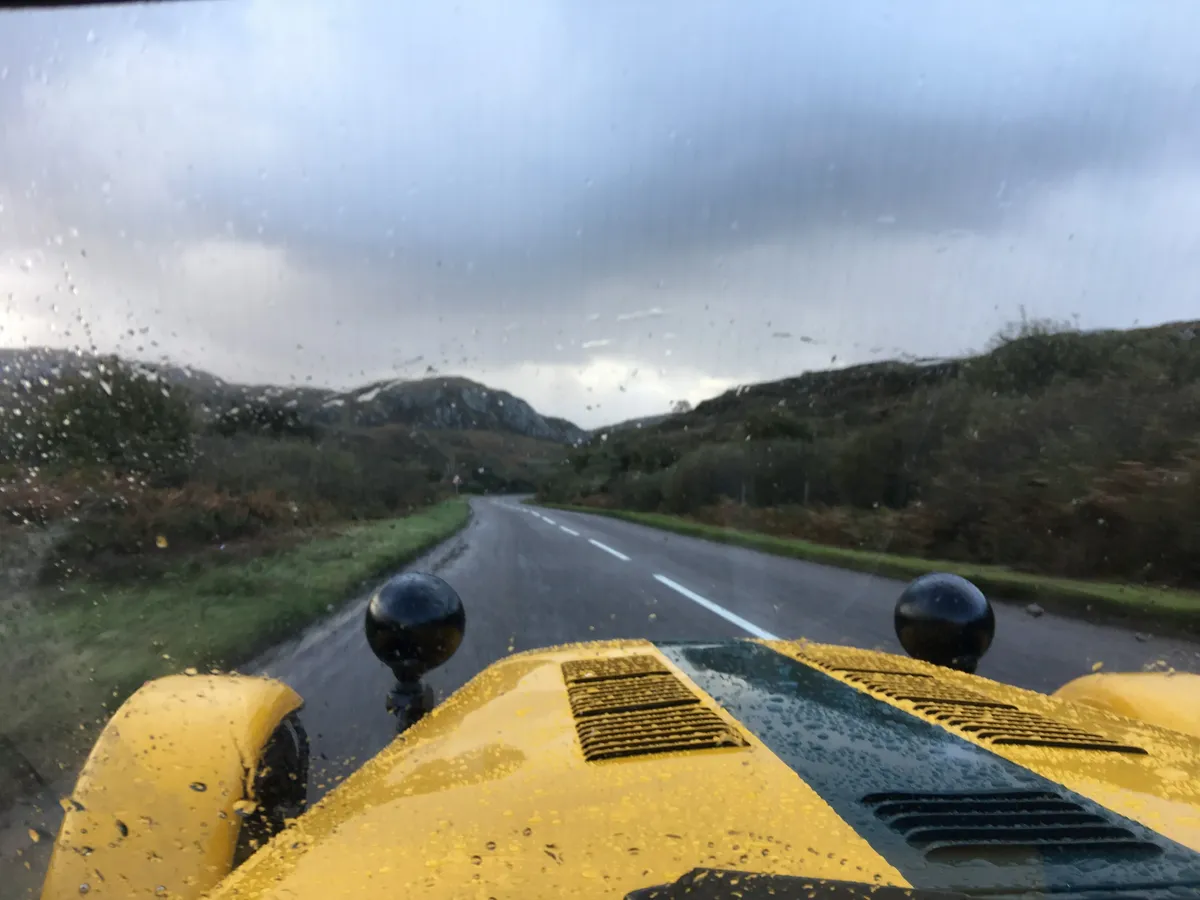
“Safety First!” I shout over the roar of the wind and the howl of the engine. Maurice clutches his muskrat hat tight to keep it from blowing off as I pull into the oncoming lane and accelerate. The spray from the truck swirls around the cockpit, tracing the eddies and vortices caused by the upright windshield and flapping doors. In a blink, we are out of the spray and past the truck. I flick the indicator toggle back to neutral and shift into fifth as I pull back into our lane, my pulse loud in my ear as Maurice’s gleefully terrified cackling fills the car.
Passing in the Caterham is a visceral experience. It starts with the downshift into third. At the middle of the powerband, the car feels like a living thing. Every twitch of my foot causes the car to tighten and flex in anticipation. The catseyes shake the car as the tires cross the centerline. Then, straightened out in the oncoming lane, and throttle open, the car leaps forward. We are pushed back in our seats, and every spare neuron is pressed into service to process the overwhelming stimuli. An overtaking manoeuvre in this car is a 2 hour long death metal concert on an airplane going through turbulence that is also full of hungry lions and angry bees, compressed into 15 long seconds. It leaves you physically and psychically bruised.
This is the story of our 818 mile journey through the Highlands of Scotland in this preposterous car.
The Drouthy Cobbler, Elgin, Dinner, Sunday
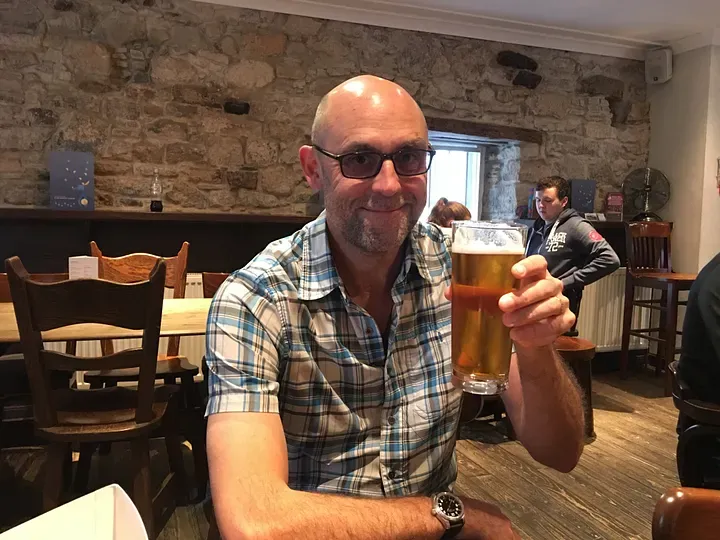 Maurice and his first warm beer
“Is it supposed to be this warm?” Maurice looks inquiringly at his pint of Tradewind. He has just arrived from Canada via the Inverness airport and an escalating series of wrong busses.
Beer in Scotland is noticeably colder than in England, probably because the cellars are too. But warm beer is where it’s at in the UK. You get used to it.
The Drouthy Cobbler is a very fine pub down a close off the high street in Elgin, where the bartenders have white shirts and full sleeve tattoos and the waitresses have slouch hats. The food was terrific. Lamb shoulder, cooked until tender, then pulled and shaped into a cube and deep fried, like a giant bauhaus meatball. Tender veg and the obligatory mashed potatoes. And enormous portions. I shove my plate back with half my mash still on it.
“You’re not going to finish that?” Maurice asks as he grabs my plate to mop up some gravy drops with my leftover potatoes.
We split a nice almond and orange cake for dessert, Maurice chucks a double espresso down his throat, and we head back to the hotel.
Elgin, 7:54am, Monday
Maurice and I stand outside our hotel, waiting for the cab we ordered last night.
“Should we call him?”
“I’m not sure. I had a very long conversation with him last night where we spent 10 minutes looking up our destination on Google maps. I know I booked it for 7:45.”
The mist begins to turn into rain, a particularly Scottish trick. Fine. I call the cab company.
“Hullo?” a very sleepy voice answers.
“Uh, I booked a cab?”
“Oh? To where?”
“Where are you two off tae?” the cabbie ask as we throw our bags in the back. Sigh.
Highland Caterham Hire, 9:00am
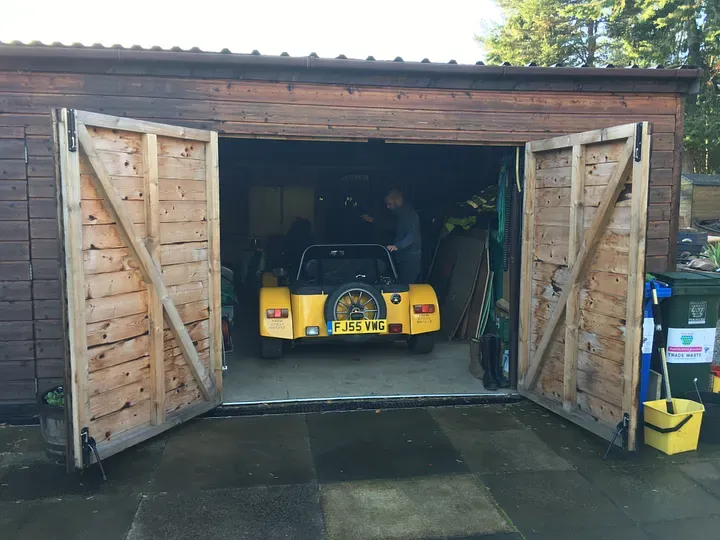 Our first glimpse of the Caterham 270
After a short safety briefing about the virtues of not hurtling through fences backwards, we walk over to a bright yellow car, no higher than my kneecaps. We do a test fitting to make sure I actually fit without the need to be lubed up. I do, barely, getting in the car with a manoeuvre that is somewhere between stepping onto a wobbly sailboat and trying to wiggle into a zipped up sleeping bag, if the sleeping bag was made exclusively of things to hit your knees and elbows on.
A Caterham is a car with everything not-car removed. In the 50’s, Colin Chapman designed the Lotus 7 as a club racer that you could drive to the track. It remained in production until 1973, when the rights to manufacture it were transferred to Caterham, a longtime Lotus dealer, where they are still made today. It’s basically the same car as it was in the 50’s, but with modern brakes and a modern engine. These do little to dilute its primordial simplicity. Our concessions to modern life are limited to a 12 volt outlet for plugging in a phone charger, and a “heater” that is just a vent in the firewall that can be propped open via a plunger hidden under the dashboard.
Inserted into the car, we set off down the road. A Volkswagen up! appears in the rearview mirror. I check the speedo – I’m going 37mph in a 50 zone. It feels like 70. I waive the up! past us like a gentleman. Still getting accustomed to the car, we proceed loudly but cautiously to our first stop – The Balvenie distillery.
The Balvenie Distillery/ Glenfiddich Distillery, Dufftown, 9:30ish
“Down here?”
“Yes, the sign at the entrance says to go under the bridge”
We have inadvertently driven into the working part of the distillery, and when we finally reach the Balvenie Visitor Center, the lack of parking, the massive trucks turning, and the strange look on the face of the security guard all conspire to help us realize our error. We get directed back onto the main road and to the visitor parking.
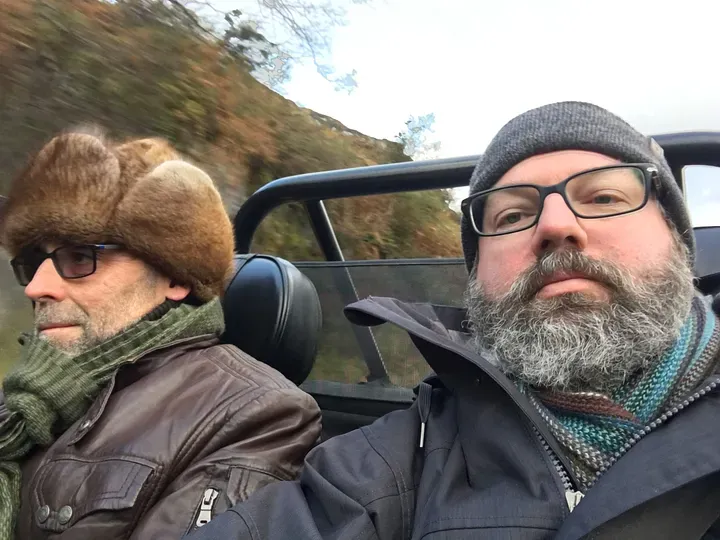 Roofless motoring in Scotland requires proper headgear
Parking the Caterham is not like parking a normal car. Once you’ve stopped, you need to get the top on, which is unrolled and attached to the windshield with two dozen snaps, then draped over the roll bar and finally strapped and cinched into place at the back. Because the top doesn’t actually prevent water from getting in the car, you also need to get the shower cap on, which is held on by various elastic bands hooked onto the bonnet clips and rear lights. It’s about a 10 minute procedure the first time we do it. We don’t get much faster with practice.
This elaborate starting and stopping procedure is the reason we decide to walk to Glenfiddich, which shares the same grounds with Balvenie, when we couldn’t squeeze into the Balvenie tour. Once again, we promptly take a wrong turn and end up wandering amongst the old stone warehouses, finally appearing at the head of the visitors entrance. We approach a dapper man, sporting a cravat, tweed trousers and tackety boots, to ask for directions.
“I saw you wandering through my distillery, but you didn’t look like you were trouble,” he tells us, as he walks us to the visitors center. He and Maurice chat enthusiastically about New Zealand all the way up to the door. “Natasha will take care of you from here. The family tree is on the left wall.” We find our new friend on the bottom right, Peter Gordon, former Chairman of Grant’s, Scotland’s largest family owned distillery group, and a descendent of its founder, William Grant.
The Old Bridge Inn, Aviemore
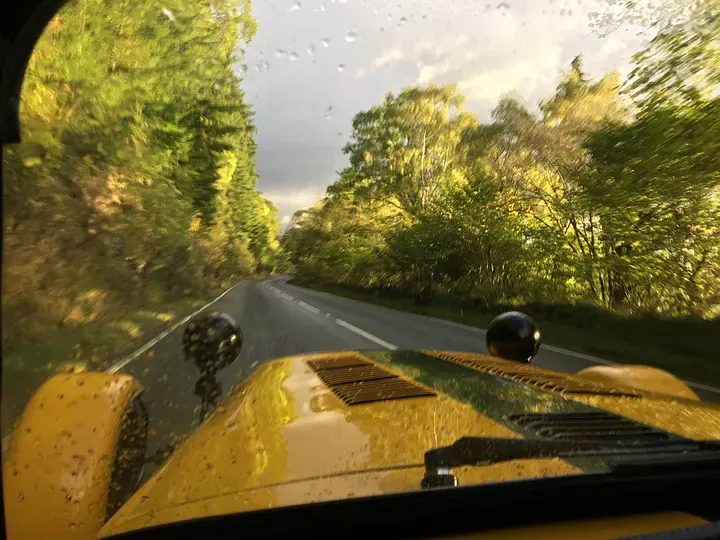 Sun showers in Speyside
The drive to Aviemore is beautiful. We jump on the B road on the other side of the river Spey from the A95, and wind in and out of forests and fields for an hour with little traffic to get in our way. The Old Bridge Inn is a fine pub just outside of Aviemore, full of dogs and dog owners. The venison salami is tremendous, and the leek and potato soup is acceptable. Warmed and rested, we head down the A86 to the A82, which will take us north to Loch Ness and Fort Augustus.
The Inch Hotel, Fort Augustus
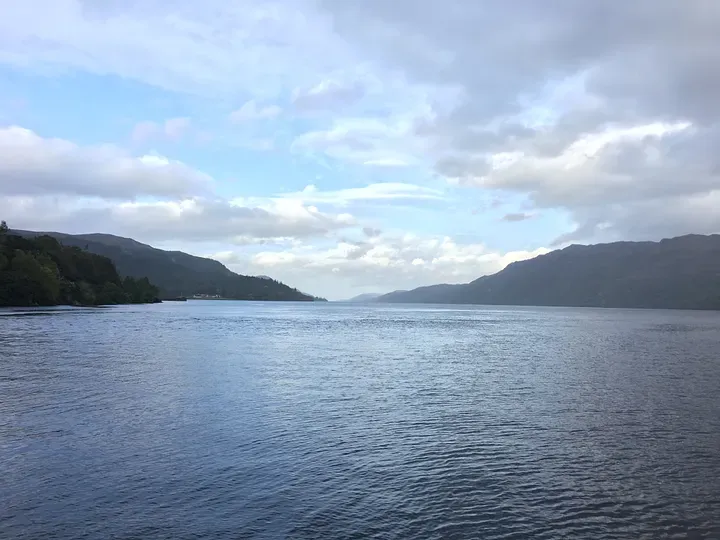 Looking north up Loch Ness from Fort Augustus
Opening the door to the Inch Hotel, we are overwhelmed with the smell of peat smoke, and the sight of tartan carpets, leather chairs and animal heads hanging on the walls. It is like a fever dream of a Scottish hotel, something Dr. Livingstone would have hallucinated in the middle of his fourth case of malaria. I’m not saying this hotel is Brigadoon, but I’m not not saying it.
Over breakfast (mediocre porridge for me, Scottish breakfast for him), Maurice mentions that he had a bit of trouble getting to sleep. He could hear a family talking and playing games in an adjacent room.
“Perhaps it was ghosts,” I say.
Maurice sits up. “Yes. Modern children don’t play games with their parents. They’d be on their phones the whole time!”
He brings up this theory to the manager during checkout. “No. You’re lying,” she says firmly. “I have to live here you know!”
Natives spooked, we bear north for our longest day of driving.
Heading out from Loch Ness, we climb up the mountains to a high valley filled with gently rolling fields. The driving is easy heading north. There’s really only one road to where we are going, but traffic is not too heavy, and the villages are not too close together. We stop for a bathroom break at Golspie, and our car attracts a crowd of old men in the parking lot, offering advice and wisdom about the roads further north.
Cairn o’Get, in some sheep paddock
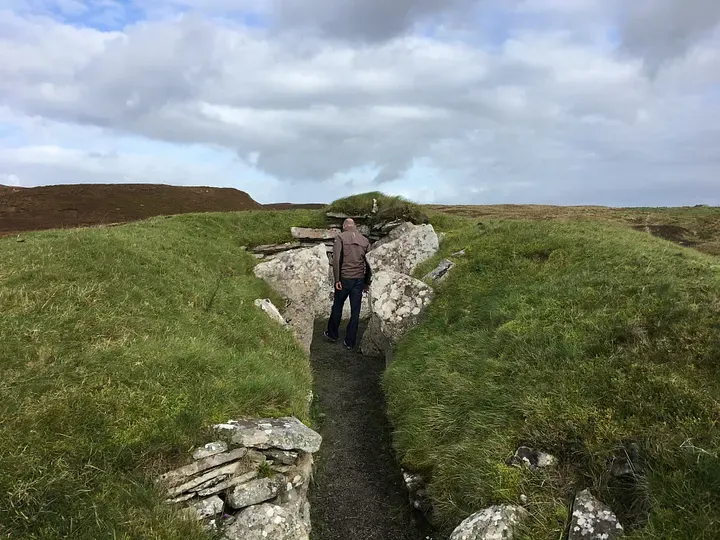
To access the Cairn o’Get, we first drive up a cart path to a farmer’s field and park the car in a mud puddle. Then we walk across a paddock full of cows to get to the paddock full of sheep. From there, we cross a peat bog then scramble up a slippery hill. From the top of the hill we are rewarded with a spectacular panorama of sea and mountain and vast expanses of heather and gorse. The cairn itself is a modest example of neolithic architecture, a low one room dry stone building whose coffered stone roof was repurposed long ago to make a nearby dam. Now mostly hidden in the turf, it is still awe inspiring to be in a 5,000 year old building overlooking the North Sea and wonder what on earth possessed them to build it. The sign speculates it was a tomb, but it was in continuous use for centuries, so it might have been a temple or meeting place. Whatever it was, the amount of dung in it suggests the sheep do not share my wonder.
Castle Sinclair Girnigoe, Noss Head
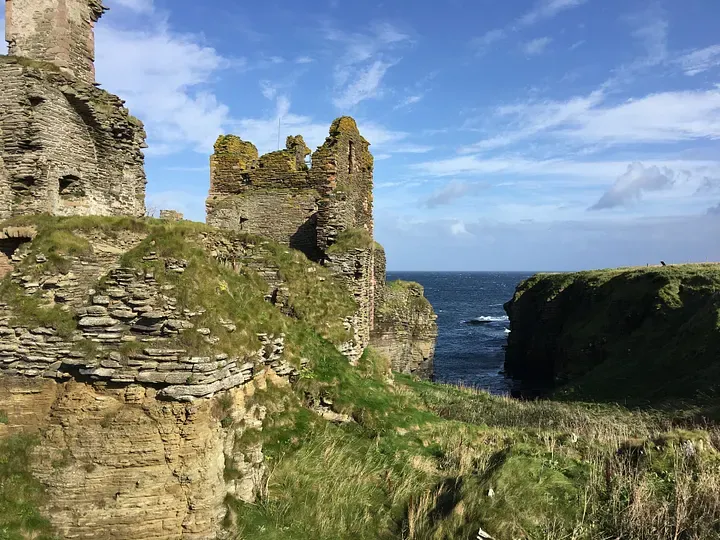 Sinclair Castle
Walking out to Castle Sinclair, we lean into the powerful North Sea wind. It’s almost impossible to talk with the wind whipping past our ears. The wind calms a bit as we approach. Almost unnoticeable from the road, it comes into stark relief as we get closer – a huge ruined tower looming over the cliffs of Sinclair’s Bay. The sea crashes into the rocks hundreds of meters below. Until a Sinclair showed up with some cannons to evict an unwanted house guest in 1680, it must have been a powerful reminder of who exactly was in charge of this particular godforsaken windblown plain.
Desperate for a pee, but unable to find a loo or even a bush, we hop back into the car and head for the northern tip of Scotland.
John O’Groats
There are some places whose placeness comes from an intrinsic genius loci, a specialness that you can sense. There are other places that are places by virtue of being where people already are. John O’Groats is just at the end of a very long road. It belongs to that category of place that exists only because of an impulse to name the edges of things. Like Cape St Vincent in Portugal, this one is surprisingly full of German caravans. John O’Groats is a place to have been. It has very little to recommend a visit.
We scarf down a microwaved cottage pie and head west.
Reay
About an hour out of John O’Groats, and almost out of petrol, we spot two pumps beside the road. We have to park on the sidewalk to fill up, the left wheels still on the road. The nozzles are padlocked to the pump. We have to rouse the ancient attendant from the store to come out and unlock them.
“Do you have any Marmite crisps?” Maurice asks.
“Sometimes,” the attendant answers, poking forlornly at the bags. Maurice grins triumphantly. This is clearly a win. For what, I’m not sure.
Cennabeinne Beach
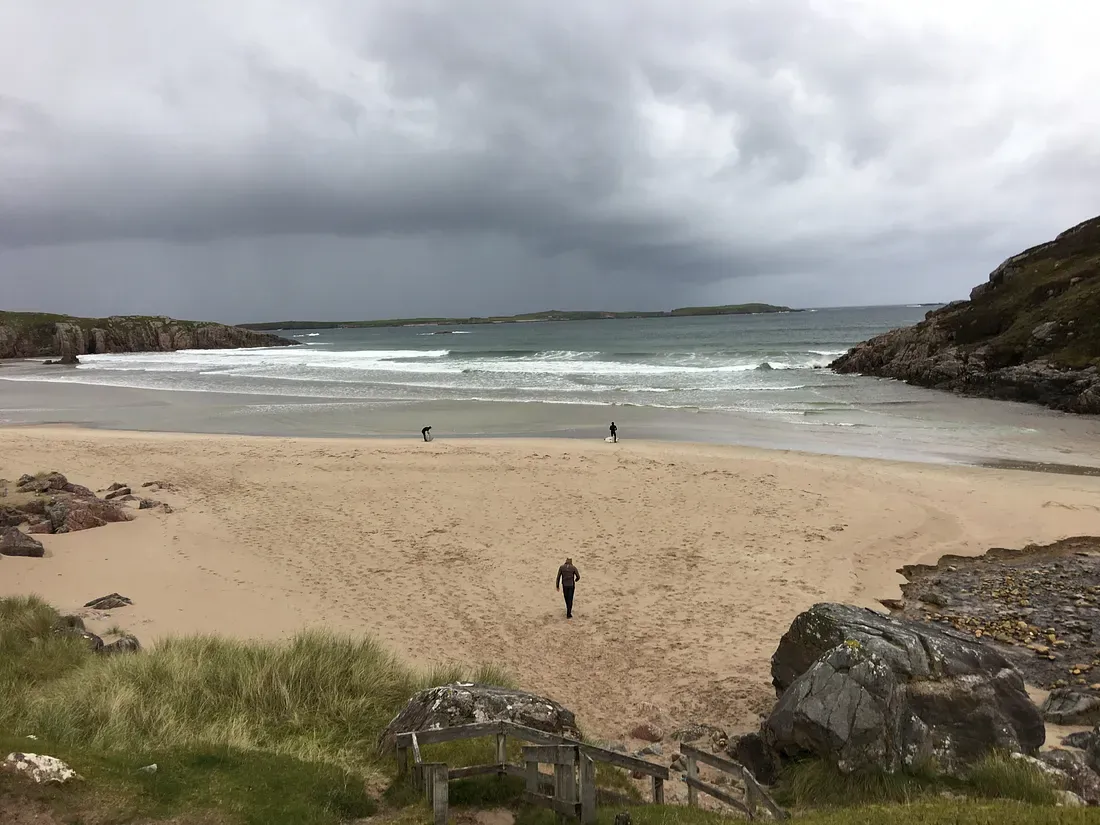 Optimistic surfers about to be interrogated by Maurice
The road along the top of Scotland is one spectacular vista after another, but rounding a corner we spot a particularly beautiful sandy bay and a parking lot. We pull over and clamber down the stairs to discover surfers wading into the water to catch the modest breaks at the entrance to the bay. Our sightseeing is interrupted by a few drops of rain. The car is 50 vertical meters above us, and the rain is starting to build. Maurice sprints ahead and wrestles the hood on by himself as I wheeze up the steps. All of us, the car included, got a good soaking, and we are in high spirits after our brush with disaster as we begin our southward leg in the least practical car ever made.
Eddrachilles Hotel, Badcall Bay, Evening, Tuesday
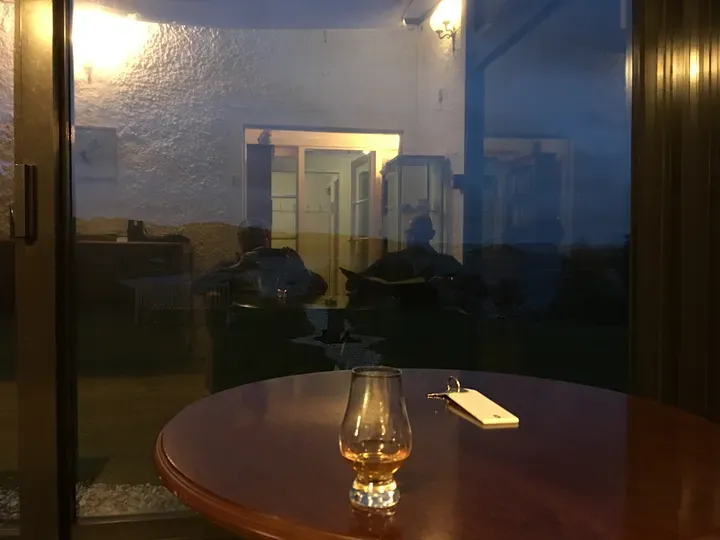 Enjoying a dram overlooking Badcall Bay
It’s only an hour drive from the beach to the hotel, but it is on a single track road across a mountain range. It is mentally and physically exhausting as we round blind corners and come face to face with sheep and oncoming cars with terrifying regularity. We have to pull over more than once to let an insane local pass us and then disappear from view with alarming speed.
Our host shows us our rooms. “They are identical, but one has a shower and the other has a bath.” I can sense Maurice’s excitement.
“You can have the bath.”
“Are you sure? Thank you!” he says as he bounces into his room.
I enjoy a quiet dram of Highland Park Dragon Legend (delicious) by the fire in the lounge and watch the light fade over the fishing boats in Badcall bay. Fresh from his bath, Maurice bounds into the lounge with a gin and tonic, and we head to the stone walled dining room for our best meal of the trip. We split a big plate of mussels, crab and langoustine salad, scallops, and steak. Stuffed, I push my plate back. Maurice looks hungrily at the few bits of fat and gristle from the steak. I nod, and he grabs it and attacks my scraps with his fork. He holds up his fork with a tiny fleck of flesh speared on it, a victorious grin on his face. “Still lots of good eating on this!”
Eddrachilles Hotel, Badcall Bay, Breakfast, Wednesday
Maurice digs into his grilled kippers. “Porridge again?”
“Yep, I’m having porridge wherever we stay. I’m ranking them – so far, Elgin was best.”
“I did the same thing once, but in Santa Fe for chimichangas.”
The Old Inn, Carbost, Isle of Skye, Lunch, Wednesday
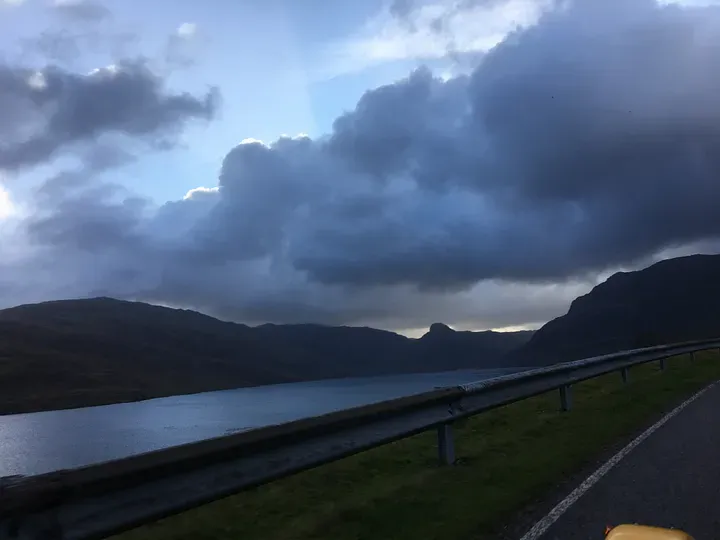 More Scottish scenery
The drive to Skye is the best and worst road of our trip. Just south of the hotel, it winds into the bare mountains, a perfectly smooth two lane wonder. We don’t see another car for hours. With great visibility, very few blind corners and no traffic, we can enjoy the car and scenery fully. But eventually we reach the coast again, and the road turns into one bumpy lane clinging to the cliffs. We flinch every time we scrape the bottom of the car on a poorly patched bit of road, keeping a watchful eye on the oil pressure, worried about the health of the oil pan. The road improves as we approach Skye, and we finally sail over the bridge and onto the island. A few wrong turns later, we arrive at The Old Inn. Car parked, we head into probably the best pub in Carbost (it’s definitely the only one), which is full of German tourists and ruddy faced locals. A warm pint and a tasty lunch prepare us for the short walk to the Talisker distillery, where we take a tour and have a wee dram to fortify us for the short uphill walk to our next destination.
The Oyster Shed, Isle of Skye, Second Lunch, Wednesday
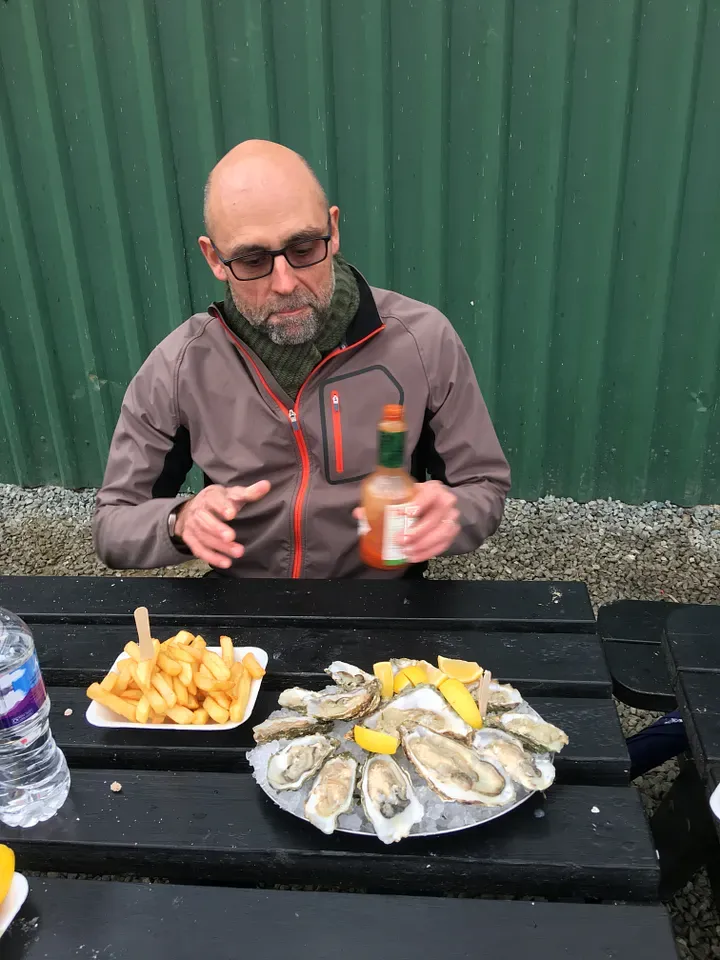 Maurice explains what gout is to me and some confused Germans
The tensor tympani is a muscle that tightens your eardrum to protect it from damage by loud noises, Maurice explains to me in a series of shouts and gesticulations over a huge plate of oysters. It’s why you think you are quieter than you are when you are trying to be quiet – you flex this muscle to attenuate your hearing. Also useful in a Caterham.
We eat our oysters, scallops and chips overlooking the village, chatting with some Germans about why they like Skye. Maurice also holds a short seminar on the causes and effects of gout, after my refusal of yet another oyster.
Full of sea creatures, we wander back to the village for a few pints and a delicious dinner at the only pub in Carbost.
Portree, Isle of Skye, Breakfast, Thursday
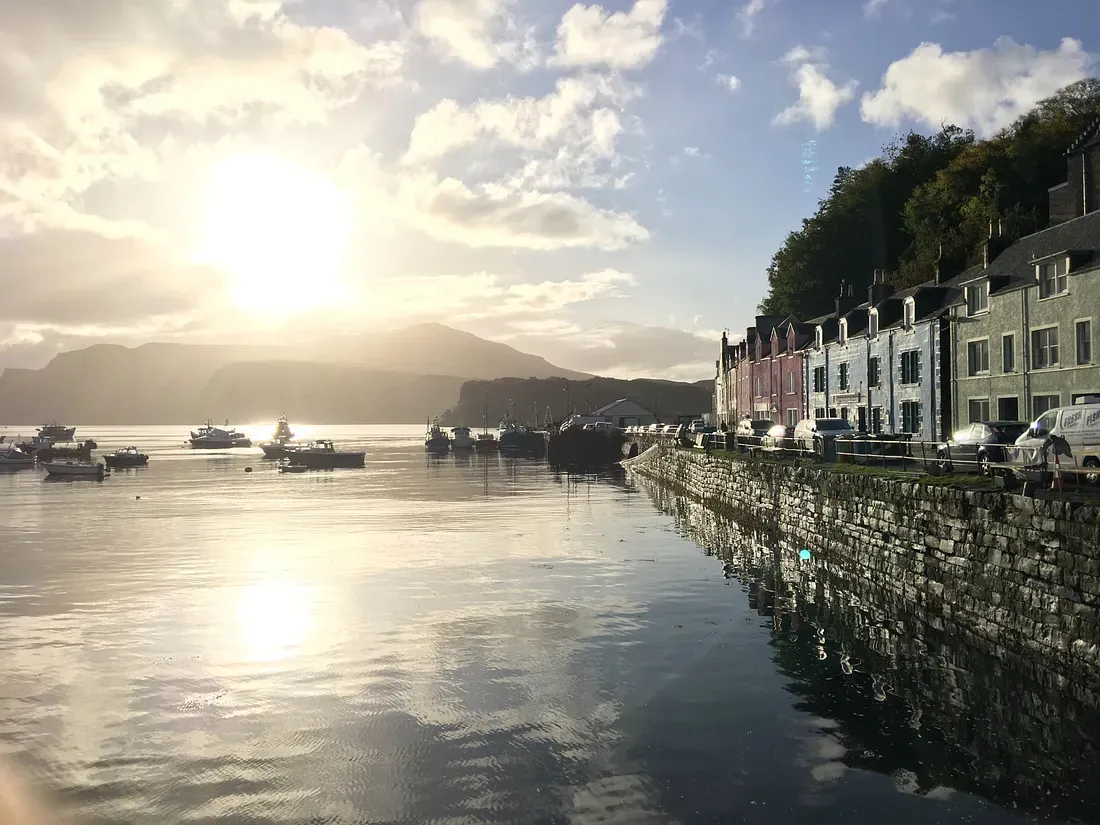 Sunrise in Portree Harbour
We leave the Old Inn before breakfast and head across the island to Portree. After a quick, greasy, traditional Scottish breakfast, we hit the road again, this time heading east back to our starting point.
We’ve both become more comfortable with the Caterham, and I am making a good pace on the road out of Skye. We come up behind an articulated lorry. We cruise patiently behind it, waiting for an opportunity.
“Safety First!” I shout over the roar of the wind and the howl of the engine. Maurice clutches his muskrat hat tight to keep it from blowing off as I pull into the oncoming lane and accelerate.
The rest of the drive to our lunch stop is uneventful by comparison, until our short lived status as the apex predator of Scottish B roads is overturned by a family in an RV.
The sun is shining as we come out of the coastal mountains, and we pull over to undo the roof and take full advantage of this rare event. As we are wrestling with the flapping bits of canvas by the side of the road, a family in an RV cruises by, waving at us out the windows in thanks for the comedy show we are putting on.
We come up on the RV a few minutes later on a long uphill straight, and I overtake them with a deafening roar. We wave back defiantly and watch them disappear in our mirrors.
Several miles down the road, climbing further into the mountains, the rain begins again. No fear, we have learned that if we keep a good pace up, the rain blows right over us. But then disaster strikes. Our beautiful two lane road unexpectedly turns into a single lane. There’s no way we’re going to stay dry while we are inching past yet another Landrover, our left tires in the grass. We pull over to put up the roof before it’s too late.
And that is where, with Maurice and I standing in the rain doing up snaps and clips, the RV passes us again, it’s occupants clearly savouring the moment. We never see it again.
Allangrange Arms, Munlochy, Lunch, Thursday
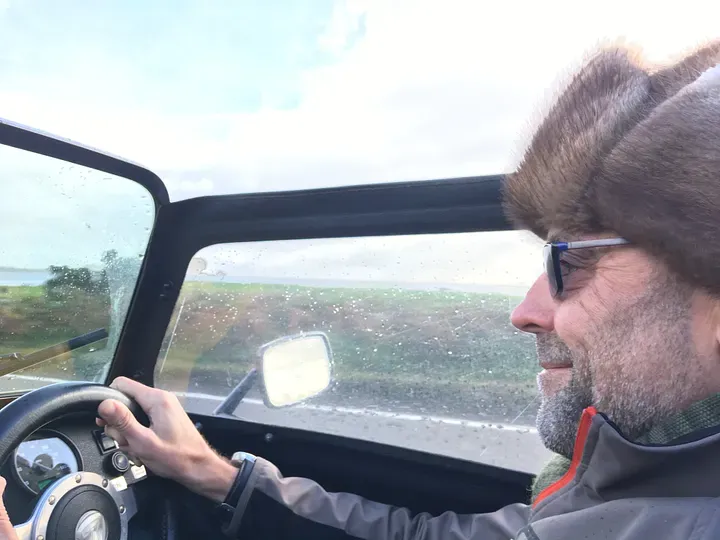 Maurice and his trusty hat
We hope to stumble across some quaint village pub for lunch, so I pull down a random side road. But the random side road quickly turns into a dirt path through a farmer’s field, and we have to reverse all the way back to the main road, open Google maps and search for “pub.” This leads us to the pleasant and friendly Allangrange Arms, where we have a light lunch and strategize about our next destination. We’re making better time than we expect, so we have time to squeeze in one more stop before we drop off the car.
The Macallan Distillery, Aberlour
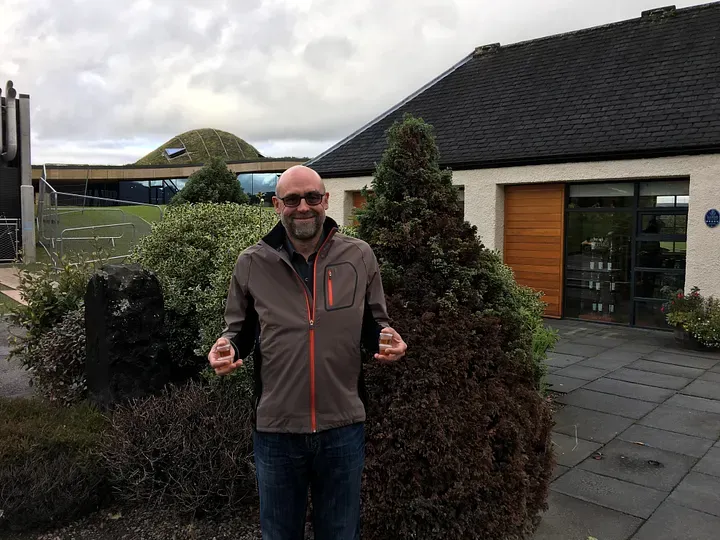 At the Macallan distillery, with our takeaway
Maurice does a good job, for him, of disguising his enthusiasm for our next destination. When we arrive at the visitor’s center, he paces back and forth, unsure of how to make the most of this stop. I encourage him to do a tasting; I can drive the next short leg. But then Maurice notices a gentleman getting his samples to go in tiny plastic cups. Aha! He springs into action, and orders two flights of Macallan’s oldest whiskeys, a 21 and a 25 year old, to go. These tiny portions are ludicrously expensive and by solving one problem, he’s created another – how to transport this liquid gold to somewhere we can drink it. Various close calls caused by balancing things on fenders and dashes finally cause him to empty his sunglasses case and nestle the four little containers inside it. We travel back to Highland Caterham Hire with Maurice holding his sunglasses case in front of him like the cub from the Lion King the whole way.
The Drouthy Cobbler, Elgin, Dinner
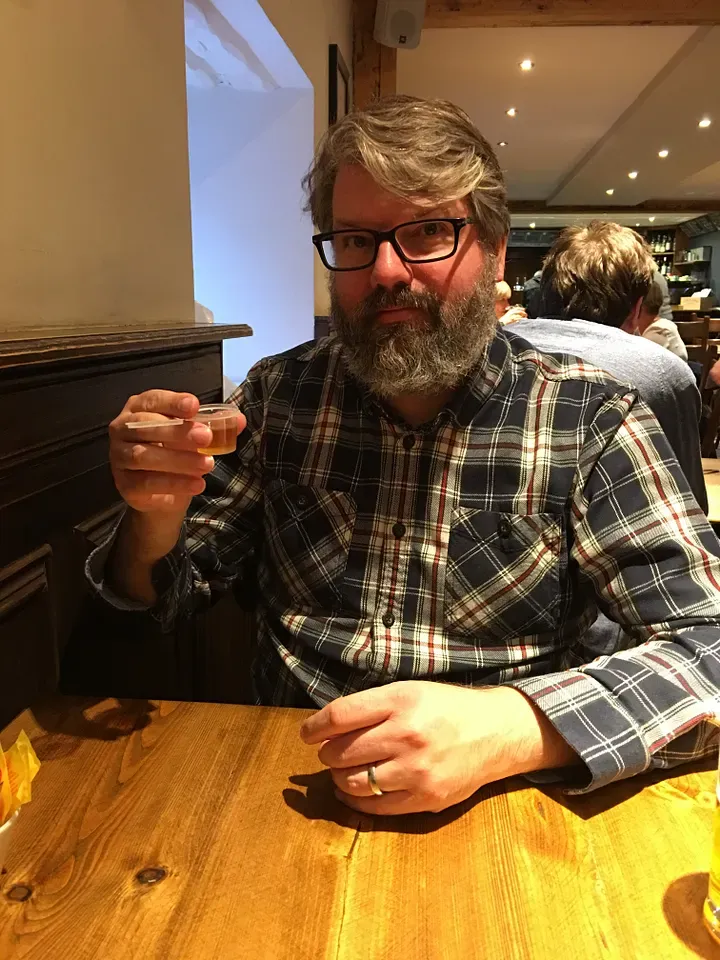 Savouring very old scotch
The sunglasses case sits on the table, it’s tiny charges safely hidden inside. We have another great meal at the pub we started at, then sneak our contraband whiskey out of it’s case. We sip our drams while I pick at an enormous cheese course and Maurice vacuums up a sticky toffee pudding.
“Thanks for coming on this ridiculous adventure with me, Maurice,” I say, as the last of the 25 year old scotch warms my throat.
“You’re not going to eat that?” Maurice asks, his fork already halfway through the hunk of blue cheese.
[note: this was originally published on Medium in 2017. Highland Caterham Hire still seems to be in business and is highly recommended. Eddrachilles Hotel is also well worth the the journey.]